

The Costly Truth Behind Doing Everything Yourself
There is a belief almost everyone carries into their first year of running an online business: if you do it yourself, it costs nothing.
No invoice arrives. No money leaves your account. So the task gets ticked off, and it feels like a win.
It is not a win. Working out the true hourly cost of a task usually proves the opposite.
Somewhere on your list this week sits a job you keep doing yourself, the same one you did last week and the week before. Formatting a page. Answering the same handful of questions. Tidying something nobody else will ever notice.
You tell yourself it only takes an hour. That is the part worth questioning. It was never free, it was only unpaid, and unpaid is not the same thing as free.
People write to me using the same words, over and over. “I’m on a Disney ride I don’t like, and I can’t get off.” More is asked of them at work each year, and less of the paycheck is theirs to keep. That feeling rarely stays at the office. It follows a person straight into the business they built to escape it.
The Math Nobody Runs
Here is a simple calculation worth running against your own week, and it takes about two minutes.
Take the income you want your business to bring in this year. Divide it by the number of hours you plan to spend getting there.
That answer is your true hourly cost, whether you have ever written it down or not.
Say your goal is thirty thousand dollars this year, and you expect to put in six hundred hours to reach it. Divide one by the other and your time is worth fifty dollars an hour.
Now take any task on your list and multiply the hours it eats by that number. A task that quietly takes ten hours a month is costing you five hundred dollars, every single month, whether anyone ever sends you a bill for it or not.
Picture the hour you spend each week untangling an invoice program you have never quite warmed to. At fifty dollars an hour, that single hour is costing two hundred dollars a month, every month, whether you notice it or not. Across a year, it is the kind of number that would make most people stop and ask why they are still doing it themselves.
The same math applies whether the number is fifty dollars an hour or five. What changes is not whether the principle holds, but how quickly the overlooked hours start to add up against you.
What That Number Does To A Decision
I came across this same thinking in something Nick James had written, and it stuck with me more than most business advice does. He runs the identical calculation before handing anything off in his own training work, and treats it as ordinary math rather than a luxury.
Once you have the number, hiring someone else to do that ten-hour task for a couple of hundred dollars stops looking like an expense. Against your own true hourly cost, it is often the cheaper option, and you get the ten hours back besides.
Think about it from the other direction too. If someone offered you fifty dollars to spend an hour formatting a page, you would likely take it without a second thought. The work itself does not change depending on who is paying for it. The only thing that changes is whether you notice the cost.
A one-time job only ever costs you once. A repeating task is a different animal. Ten hours a month, left alone, adds up to well over a hundred hours across a year, quietly spent on something you were never the only person who could do.
I spent decades in a profession where every hour was accounted for one way or another, long before I ever started this second business. I am used to looking at time that way. It still surprised me how rarely I applied the same honesty to my own online work, where nobody was keeping score but me.
Look at your own calendar from last month. The chances are good that at least one entry repeats itself almost word for word. The same software login reset, the same customer question copied and pasted into a reply, the same page rebuilt because a product changed. None of it individually feels large. Add the minutes together and the shape of the problem usually surprises people the first time they do the adding.
Three Honest Questions Before You Hand Anything Off
The math tells you what a task costs. It does not tell you whether you should keep it.
Three questions round out the picture. Are you good at this task, or only capable of finishing it? Do you enjoy it, or does it sit at the bottom of your list every week, which quietly raises the real cost further than the simple math suggests?
Take the formatting example again. You may be perfectly capable of laying out a clean page. Capable is not the same thing as being the best use of your hour. The same hour spent talking with a customer who is stuck, finding out what they actually want, is worth more to your business than either of you might expect.
This applies just as much to tasks you have quietly decided to treat as proof of commitment. These are the ones you insist on doing yourself because dropping them would feel like giving something up. The math does not care about the story behind a task. It only asks what the hour was worth while you were doing it.
And does it need to sound like you specifically? A personal reply to a worried customer probably belongs on your desk. The formatting behind it rarely does.
I have written more about running a business by the numbers that matter most, rather than the ones that only look good on a screen, in other articles I have shared recently, and this same quiet math shows up again and again once you start looking for it.
Where My Own Man Friday Already Does This
I handle customer management, page hosting and the back-and-forth of emails and texts through eShowcase, which I have come to think of as my own man Friday.
Before it, those were hours I spent myself, every week, on work that never once required my judgment. It just required doing. Handing that part off was the first time I ran this exact calculation against my own business, rather than only recommending it to somebody else.
That handoff did not happen overnight. It took sitting down and admitting that a task I had always assumed was mine to do was never really mine at all. It was just a task nobody had gotten around to pricing properly. Once it had a number attached to it, the decision made itself.
It is not about removing yourself from the parts that matter. It is about being honest enough to notice which parts those really are.
Start With One Hour
You do not need to hand off five tasks this month. Pick the one task you dread most, run the true hourly cost math against it, and decide with a number in front of you instead of a guess.
Most people who try this calculation for the first time pick the task they already suspect is costing them the most. They are usually right. The surprising part is rarely the existence of the cost. It is how long the same task had been sitting there, quietly repeating, before anyone bothered to add it up.
Understanding what a customer wants, and finding where they are stuck, is work only you can do well. Formatting a page so it looks tidy is not. Most people never separate the two, so the second kind quietly eats the hours that belonged to the first.
None of this is about doing less. It is about finally being paid properly for the hours you keep, instead of spending them somewhere they were never worth the most.
If building a business around fewer wasted hours and steadier recurring income is where you want to go next, Serious About Six Figures is worth a look. It is Nick James’s own year-long training, covering income, list building, traffic and working fewer hours on rotation, month by month. I am not suggesting it because I have been through every lesson myself, but because the thinking behind it lines up closely with the math above, and it may be the next honest step if this is the problem you are facing.
Run the numbers on one task this week. You may be surprised at what it has quietly been costing you all along.
All the best, Jon
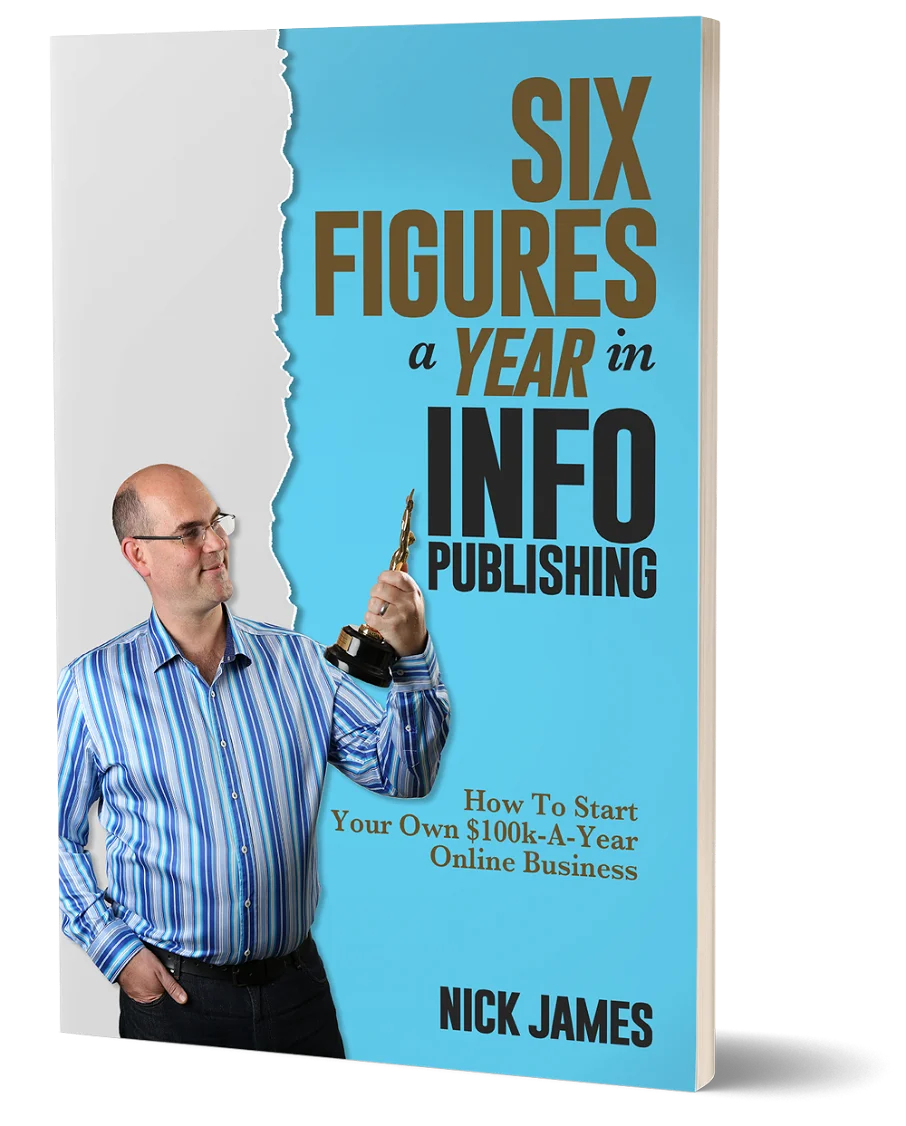
Author offers a FREE copy of this book to his next door neighbor... to prove he's not a drug dealer!
Now claim your FREE COPY.
and follow the step-by-step instructions for making the kind of money (and living the kind of lifestyle) that'll get your neighbors curtains twitching with curiosity!
Enter your details below to discover how to claim your FREE COPY of 'Six Figures A Year In Info Publishing' ...
Privacy Policy : We value your privacy. You can unsubscribe from receiving future emails with 1 click at any time.