

How to Build a Thriving Email List Without Posting on Social Media Once

Let’s get the heresy out of the way early: you do not need social media to build a great email list.
Not Instagram. Not LinkedIn. Not TikTok, Threads, X, or whatever new platform is currently demanding your time, your attention, and your sanity while paying you back in vague “exposure” and the occasional dopamine hit.
A growing number of marketers are quietly stepping off that treadmill. They’re building serious, highly engaged email lists without posting daily, chasing trends, or trying to reverse-engineer an algorithm that changes its mind every six weeks. And the surprising part? They’re not falling behind.
They’re pulling ahead.
Less noise. Better subscribers. More control.
This isn’t a manifesto against social media. If it’s working for you—if you genuinely enjoy it, if it drives real revenue—keep going.
But if you’ve ever caught yourself thinking, “There has to be a better way than this”… there is.
And it’s not even new. It’s just been overshadowed by louder, flashier tactics.
AI SEO: The Slow Burn That Quietly Wins
Traditional SEO was about ranking on Google.
AI SEO is about showing up wherever people ask questions—Google, yes, but also AI assistants, answer engines, and platforms that are increasingly shaping how people discover and trust information.
This is a subtle but massive shift.
Instead of optimizing for a single search engine, you’re now creating content that gets referenced. Quoted. Summarized. Pulled into answers. Recommended.
Which means one strong piece of content doesn’t just sit on your site—it travels.
And it keeps traveling.
The core strategy hasn’t changed: create content that directly answers what your ideal subscriber is already searching for. But the payoff has multiplied. A well-structured, genuinely helpful article can now bring in traffic from multiple directions—search results, AI responses, niche communities, even word-of-mouth sharing.
But here’s where most marketers still miss the point: traffic is not the goal.
Conversion is.
A generic “join my newsletter” box is invisible. People don’t wake up hoping to subscribe to something. They subscribe when there’s a clear continuation of value.
That’s where content upgrades come in.
A checklist, a template, a swipe file, a calculator—something that feels like the natural next step from what they just consumed. Not a leap. A continuation.
They’re not opting in because they like you.
They’re opting in because you just helped them—and you’re offering more of that exact help.
Also, stop chasing big, vague keywords. They look impressive, but they’re mostly noise.
High-intent, specific searches win. The slightly awkward, overly specific phrases that signal someone is actually trying to solve a problem.
Less traffic. Better people.
And in this game, better people beat bigger numbers every time.
Podcast Guesting: Borrowed Trust Is Still the Fastest Shortcut
Here’s something most marketers underestimate: trust transfers.
When you show up on a podcast, you’re not starting from zero. You’re stepping into a relationship that already exists between the host and their audience.
And that changes everything.
A listener who hears you speak for 30–60 minutes doesn’t see you as a random marketer. They’ve heard your thinking. Your tone. Your perspective. By the time you mention your site or offer, you’re already halfway past the skepticism barrier.
Compare that to social media, where you have about three seconds to prove you’re worth paying attention to.
It’s not even close.
But this strategy only works if you finish it properly.
Sending podcast listeners to your homepage is one of the biggest missed opportunities in marketing. It’s like inviting someone into your house and then shrugging when they ask where to go.
Instead, create a dedicated landing page tied to the episode. Speak directly to that audience. Reference what you talked about. Offer something that feels like a natural extension of the conversation.
Because that listener? They’re not cold traffic.
They’re as warm as it gets.
And if you handle that moment well, you don’t just get a subscriber—you get someone who already trusts you before they’ve read a single email.
YouTube: The Asset Most Marketers Are Underusing
YouTube is still wildly misunderstood.
Most people treat it like a social platform—post content, hope it gets picked up, maybe go viral if the algorithm feels generous that day.
That’s backwards.
YouTube is a search engine. A massive one. And unlike social platforms, it has a long memory.
A good video doesn’t disappear after 24 hours. It compounds.
The strategy here is deceptively simple: figure out what your audience is actively searching for, then create videos that answer those questions clearly, directly, and better than the alternatives.
No fluff. No overproduction required.
Just clarity.
When someone searches, clicks your video, and watches you solve a problem step by step, something important happens—you earn credibility. Not because you said you’re an expert, but because you demonstrated it.
And that’s when the opt-in works.
Placed in the description, the pinned comment, and the end screen, your offer becomes the next logical step. Not a distraction. Not a pitch. A continuation.
Each video becomes an asset. Something that can generate traffic and subscribers long after you’ve moved on to the next piece of content.
Try getting that kind of longevity out of a tweet.
Reddit: Earned Attention in an Age of AI Amplification
Reddit is where lazy marketing goes to die.
You can’t fake your way through it. You can’t drop links and expect results. And you definitely can’t treat it like just another distribution channel.
But if you approach it with the right mindset—patience, curiosity, and a willingness to actually help—it becomes incredibly powerful.
Especially now.
Because Reddit content is increasingly being surfaced in search results and fed into AI-generated answers. That means a thoughtful, detailed response in the right thread doesn’t just live on Reddit—it spreads.
Quietly. Repeatedly. At scale.
The strategy is simple in theory: show up, answer questions, and be genuinely useful.
No shortcuts.
Follow the 9:1 rule—nine valuable contributions for every one time you mention your own content. And even then, only when it’s truly the best possible answer.
This takes restraint. Most marketers hate that.
But the payoff is real.
Because when someone finds you through a genuinely helpful interaction—one where you weren’t trying to sell them anything—they arrive with a completely different mindset.
They don’t feel marketed to.
They feel helped.
And those are the people who stick.
Partnerships and Newsletter Swaps: Leverage Without the Grind
Everything we’ve covered so far builds momentum over time.
Partnerships compress time.
When someone you trust recommends a new voice, you pay attention. You’re more open. Less skeptical. Already halfway convinced.
That’s the power of a good newsletter swap.
Two creators. Overlapping audiences. Mutual recommendation.
Done right, it’s one of the fastest ways to grow a list with qualified subscribers.
Not just more people—better people.
But this only works if you’re selective.
Audience overlap matters. Content quality matters. Values matter.
Because you’re not just sharing audiences—you’re sharing trust.
One bad recommendation can damage your relationship with your list. One great one can deepen it.
Beyond swaps, look at co-created webinars, collaborative lead magnets, and bundles where multiple creators contribute value to a single offer.
These aren’t just growth tactics.
They’re trust accelerators.
The Bigger Point
Social media isn’t evil, but it is rented. You don’t control who sees your content. You don’t control how long it lasts. And you definitely don’t control the rules.
Email is different.
It’s owned. Direct. Durable.
While a social post might reach a fraction of your audience, email consistently shows up—day after day—with open rates that most platforms can’t touch.
And building that list without social media?
Not only possible—it’s often smarter. More stable. More predictable. Less exhausting.
But it requires a shift.
You stop thinking like a performer chasing attention…
…and start thinking like a publisher building assets.
You create things that last.
You meet people where intent already exists.
You build trust before you ask for anything in return.
Because attention is fleeting.
But trust?
That compounds.
And the algorithm doesn’t own any of that.
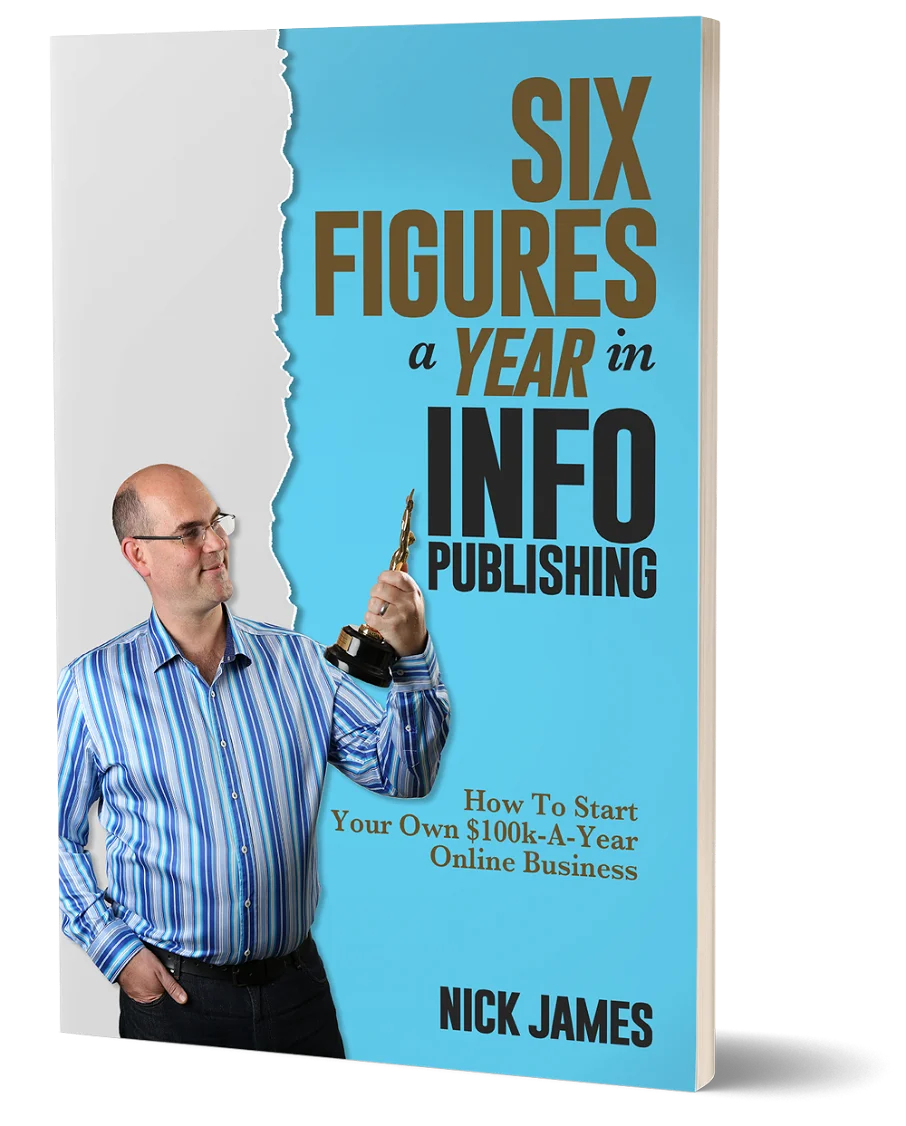
Author offers a FREE copy of this book to his next door neighbor... to prove he's not a drug dealer!
Now claim your FREE COPY.
and follow the step-by-step instructions for making the kind of money (and living the kind of lifestyle) that'll get your neighbors curtains twitching with curiosity!
Enter your details below to discover how to claim your FREE COPY of 'Six Figures A Year In Info Publishing' ...
Privacy Policy : We value your privacy. You can unsubscribe from receiving future emails with 1 click at any time.